July’s Market Extremes
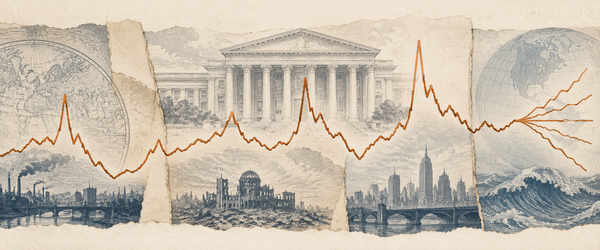
The S&P 500 barely moved, but beneath the index, July produced historic moves across individual stocks, semiconductors, and overseas markets.
Leopold Aschenbrenner lost an estimated 67% in July even though the S&P 500 barely moved. His portfolio appeared hedged but behaved as if it carried the same AI narrative twice: long the builders and short the expected losers. When that relationship reversed, both sides lost. The exact July
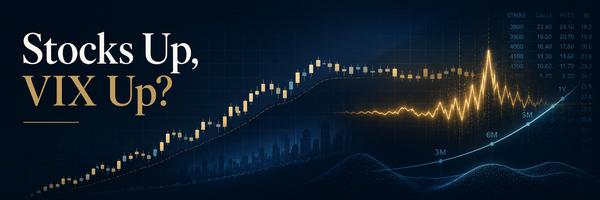
July has historically delivered positive equity returns alongside a rising average VIX. The explanation is not that stocks and fear normally rise together. The gains tend to arrive first, while volatility reprices later.
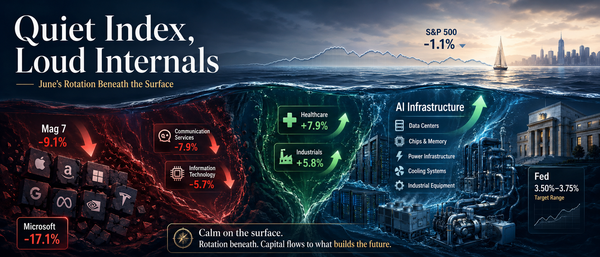
The S&P 500 finished June down only 1.1%, but the calm index hid a much louder market underneath. The Mag Seven lagged, Microsoft fell 17.1%, healthcare and industrials rallied, and AI leadership moved toward the physical infrastructure layer.
Runtime was built around a simple principle: alignment should be real.
People sometimes ask a fair question: Why can't someone else copy this? Or, with AI improving so quickly, won't an AI system or future superintelligence be able to do it anyway? The answer is that intelligence is not enough by itself. Before a person, company, or
When AI makes static software easy to copy, durable advantage moves to systems that learn from proprietary context, action, measurement, and improvement.
A market lesson from April 2026: rallies often begin before fear clears, reinforcing the value of systematic participation through uncertainty.
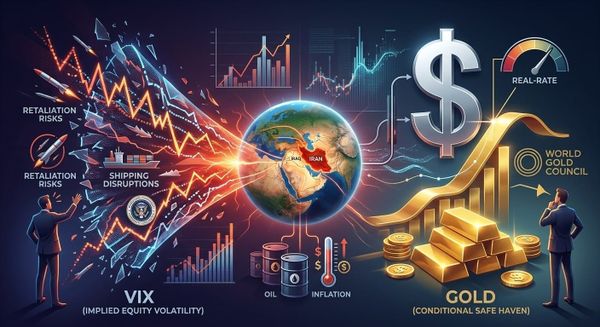
A research note on VIX, gold, and geopolitical risk, and why portfolio design must account for how uncertainty transmits through markets.
Runtime Fund's core investment thesis: long-term compounding is a portfolio engineering problem, shaped by systems, risk discipline, and compute.