IQ per Watt, Equity per Human

A former colleague, one of the sharpest engineers I know, called me recently. AI, he said, had made him ten times more productive. He was shipping more, solving more, delivering more than ever. And yet his salary hadn't moved. The gains were real, but they weren't his.
He had run into one of the oldest truths in economics: productivity and ownership are not the same thing.
A salary is a price, set by the market for your labor, not by the value you create. When a tool multiplies your output tenfold, the market doesn't pay you ten times more. It simply learns that your kind of work is now ten times cheaper to produce. The surplus doesn't disappear. It flows to whoever owns the enterprise. It always has.
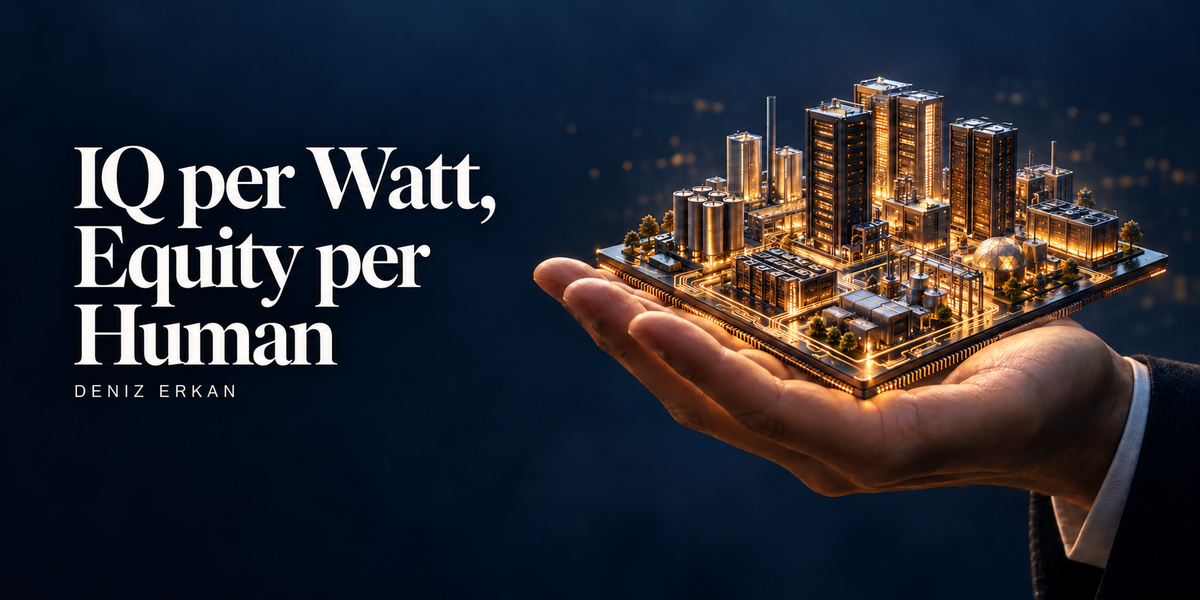
This is why I think most of the conversation about AI is framed wrongly. We debate its intelligence, its "IQ per watt," as if the central question were technical. It isn't. The central question is one of capital allocation: who owns the machines, and therefore who owns the output?
I expect machines to surpass us on intelligence per unit of energy. I expect companies' AI workforces to outnumber their human ones. When that happens, revenue per human employee will stop being a modest efficiency metric and become a measure of how much capital each person commands.
We can already see the curve bending. Microsoft holds a special place for me, having worked there, and its revenue per employee has more than doubled since 2010:
Microsoft revenue per employee

2010  ███████          $0.70m
2015  ████████         $0.79m
2020  █████████        $0.88m
2025  ████████████     $1.24m
2026  ███████████████  $1.49m
Annual revenue in nominal dollars divided by year-end full-time employees. Sources: Microsoft annual reports, FY2026 revenue and headcount.
Follow that line forward. $10 million per human employee. Then hundreds of millions. Perhaps, one day, billions. Charles Stross imagined this in Accelerando: an economy that gradually becomes something machines run among themselves, with humans increasingly at the edges. Science fiction has a way of becoming a forecast.
We are living a version of it at Runtime. Our AI workforce now carries a growing share of the operational work people once did. We scale with fewer humans, and those humans spend more of their time on research, on the questions machines can't yet frame for themselves.
The risk no one is pricing
Here is where I think in terms of risk. A salaried employee in the AI era holds a strange portfolio. Nearly all of their wealth is concentrated in a single asset, their labor, sold to a single buyer, their employer, at a price that technology is actively pushing down. They take on the volatility of their company's fortunes without participating in its upside.
No serious allocator would construct a portfolio like that. Yet it's the default position for most working people.
The rational response is to rebalance: to convert labor into ownership.
What I told him
If you're that good with AI, go build something of your own. Take that tenfold capacity and point it at an asset you own, so the surplus you generate compounds for you rather than for someone else. And if building isn't right for you now, become a shareholder in the company you work for, so you share in the gains you help create.
And if your company doesn't offer employee ownership, find a publicly traded company that is a good proxy for your line of work and buy its shares. I believe this singularity will eventually reach every company.
In the economy that's coming, the most important question won't be how capable you are. It will be what you own.
Stop renting out your intelligence. Start owning what it builds.
— Deniz Erkan