
VIX, Gold, and the Geopolitical Premium
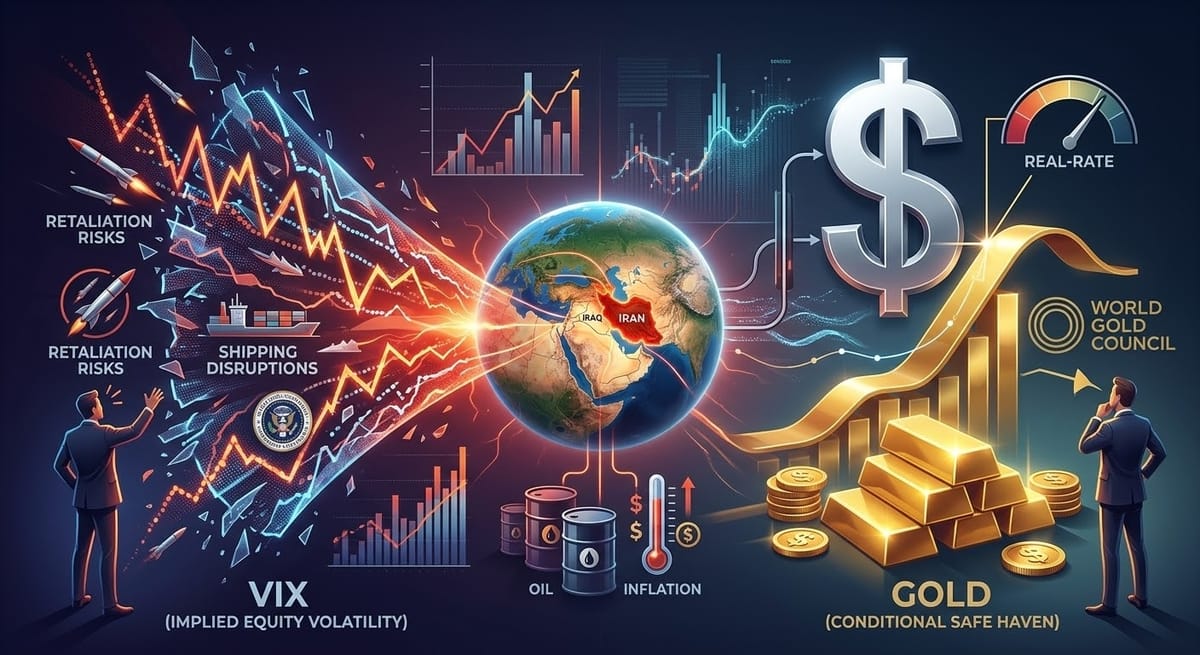
As the U.S.-Israel conflict with Iran widened, markets repriced uncertainty quickly. The VIX closed at 23.75 on March 5, up from 14.51 on January 2, a rise of about 63.7%. Spot gold was around $5,095.78/oz on March 6, up from about $4,372.35/oz at the start of the year, a gain of roughly 16.5%. So both implied equity volatility and demand for value preservation are higher than they were at the beginning of 2026.
The key distinction is between the known and the unknown. The existence of geopolitical tension was known for months. What markets could not fully price was the timing, severity, and transmission path once the conflict expanded: retaliation, shipping disruption, higher oil, higher inflation expectations, and policy spillovers. That widening range of possible outcomes is what the VIX is really capturing. Reuters noted this week that the VIX is hovering above 20 and has posted its biggest weekly rise since last November, but it is still far below full-crisis extremes.
Gold’s reaction matters, but its relationship with the VIX is more subtle than the usual “fear up, gold up” shorthand. Historically, gold has often acted as a safe-haven asset during geopolitical crises, and the World Gold Council says spikes in geopolitical risk usually coincide with equity selloffs while gold has delivered robust returns in such episodes. The same group has also argued that, over the long run, gold has generally been an effective hedge in diversified portfolios.
But history also shows that gold is not a pure VIX mirror. In sudden liquidity events, gold can initially sell off even as fear rises. The World Gold Council notes that during 2008 gold experienced pullbacks of roughly 15% to 25% in U.S.-dollar terms at points during the crisis before ending the year as one of the few major assets with a positive return. That is an important template: in severe stress, investors sometimes sell gold too, either to raise cash or because the dollar and real-rate channel temporarily dominate the haven channel.
Recent geopolitical episodes show the same pattern. When Iran launched missiles at U.S. bases in Iraq in January 2020, Reuters reported that gold blasted above $1,600/oz, the yen strengthened, and oil jumped, but the safe-haven dash faded within hours as broader markets steadied. During Russia’s invasion of Ukraine in February 2022, Reuters reported that gold prices swung sharply and even reversed lower within a day, slipping to about $1,887/oz after the initial surge. In other words, gold often reacts positively at first, but the move is rarely clean or one-directional once markets start processing second-order effects.
That historical pattern is exactly why it is more accurate to say that gold and the VIX have a conditional relationship rather than a permanent one. Academic and market research broadly supports that gold tends to respond positively to spikes in uncertainty, but usually more weakly and less consistently than the VIX itself. One recent study summarized by ScienceDirect finds that gold and the U.S. dollar tend to respond positively to higher VIX values, while an earlier paper found that the VIX was a stronger hedge and safe haven than gold over its sample period. So gold often participates in risk-off episodes, but it does so through a wider set of channels: safe-haven demand, inflation expectations, the dollar, real rates, and liquidity.
So how has this conflict played out so far?
The answer is: more orderly repricing than outright panic. The VIX has risen materially, moving from 19.86 on February 27 to 21.44 on March 2, 23.57 on March 3, 21.15 on March 4, and 23.75 on March 5. That is a real repricing of uncertainty, but still well below the kind of vertical spike associated with a systemic global liquidation event. Reuters explicitly described the move in volatility as meaningful but “relatively benign” compared with past full-blown crises.
Gold has behaved in a way that fits the historical template. Reuters reported that on March 4 spot gold rose to about $5,120.71/oz as the escalating Middle East conflict attracted safe-haven buying, but that move came after a drop of more than 4% the previous day. By March 6, spot gold was at $5,095.78, and Reuters said it was on track for a 3.4% weekly decline, even though the conflict had intensified further. Reuters also noted that the stronger U.S. dollar was making gold more expensive for overseas buyers and limiting the haven bid.
That tells us something important. So far, this conflict has produced a positive but messy VIX-gold relationship. Both are elevated versus the start of the year, which is consistent with a rising geopolitical premium. But gold is not moving in lockstep with every volatility jump because the same conflict is also strengthening the dollar and reviving inflation concerns via oil. Reuters noted that crude was headed for its sharpest weekly gain since Russia’s invasion of Ukraine, which reinforces the inflation channel and complicates the safe-haven trade in gold.
So the clean conclusion is not that “gold equals fear,” or that gold mechanically tracks the VIX. The better conclusion is this: the VIX is directly pricing a wider cone of possible equity outcomes, while gold is pricing a mix of fear, inflation hedging, dollar strength, and liquidity conditions. In mild-to-moderate geopolitical shocks, both can rise together. In sharper or more disorderly episodes, gold can hesitate, reverse, or lag even as implied volatility keeps rising. That is what history suggests, and it is also what the current Iran conflict appears to be showing in real time.
For portfolio design, that nuance matters. Elevated VIX means the market is demanding more optionality against adverse outcomes. Elevated gold means investors still want some protection outside the equity-bond complex. But this week’s action is a reminder that “safe haven” is not one thing. The channel matters. If the dominant channel is pure fear, gold often helps. If the dominant channel becomes dollar strength, real-rate pressure, or forced liquidation, gold may still hold up over the medium term while underperforming in the short term.
Engineered compounding,
Deniz Erkan